
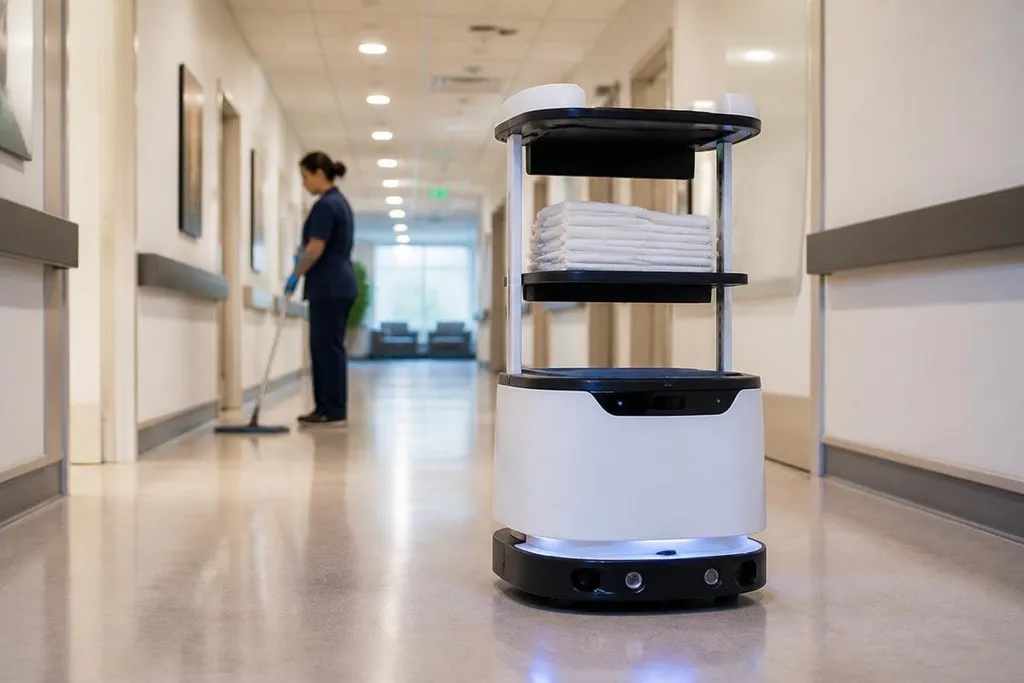
A service robot works where people need a repeated physical task done: moving supplies, cleaning floors, carrying meals, or checking a site. Its value grows when the task happens often, follows a clear route, or puts a person near avoidable risk.
For an operations manager, the useful question is not whether a robot looks advanced. It is whether the robot can finish one job with less delay, less strain, or fewer handoffs.
- Service robots take on repeatable work in public and work spaces.
- Their best results come from clear routes, known objects, and steady demand.
- Human staff still handle exceptions, safety decisions, and tasks that change often.
Where service robots fit
Service robots operate outside factory production lines. A cleaning robot works in a hotel, airport, or office. A mobile robot may carry linen through a hospital or move food from a kitchen to a ward. An inspection robot can check a confined or unsafe area while a person watches the results.
These jobs share a useful feature: the work can be described in steps. The robot needs a way to sense its surroundings, choose a route, avoid people, and stop when something changes. A mobile robot may use LiDAR, which measures distance with laser light, along with cameras and software that maps its route.
The task still needs a clear limit. A robot that carries sealed bins between two fixed points has a simpler job than one that must pick loose objects from a crowded room. That difference affects the price, setup time, and amount of human help required.
Why the demand is growing
Repeated service work can consume a large part of a shift without needing much judgment. Staff may spend time pushing carts, checking empty rooms, carrying supplies, or walking between work areas. A robot can take on some of that movement while people stay with work that needs care or a decision.
This matters most when the task happens through long operating hours. A robot can run a route during quiet periods, return to a charging dock, and start again when the system allows it. The result depends on battery runtime, charging time, floor access, and how often a person must clear an obstacle.
Doors and lifts can turn a service robot’s route into a staff task, even when its battery lasts through the shift. Robot 24 can place those field conditions beside the model, site, date, and reported result, so you can judge the limits that come next.
The limits are part of the case
Service robots don't remove the need for staff. They shift the work. Someone must charge the robot, inspect it, respond to alerts, keep routes clear, and fix failures. A hospital robot may move a cart correctly yet stop when a visitor stands in its path.
The setting also matters. A tidy warehouse gives a mobile robot clear routes. A hotel has guests, luggage, wet floors, narrow lifts, and doors that may not open from software control. Each added condition raises the number of cases a person must handle.
Data and privacy can matter too. Cameras and location sensors may record people, rooms, or work patterns. A deployment needs clear rules for access, storage, and deletion before the robot enters a public space.
I’d judge a service robot by the work it completes without a person standing beside it, not by the smoothest minute of its demo.
A practical buying check
Before you compare models, write down the task and watch it for a full work period. Then check:
- Route: Can the robot reach every required point without stairs, narrow doors, or manual gates?
- Load: What does it carry, and what happens when the load is uneven, wet, or larger than planned?
- Runtime: How long does it work before charging, and how long does charging take?
- Recovery: Who receives an alert when it stops, and how long does a normal recovery take?
- Safety: Where is the emergency stop, and how does the robot behave near people?
- Cost: Add installation, software, service visits, batteries, and staff time to the purchase price.
The first useful deployment is often a narrow route with a clear finish point. That gives the team a way to count completed trips, stops, human interventions, and missed tasks before the robot takes on more work.
Service robots are becoming more important because they can handle selected physical tasks across long operating periods, but their value stays tied to the site. The next decision is concrete: measure one route, record every human intervention, and expand only if the numbers improve.